Your TMS knows what left the dock. It usually does not know what happened at stop 14. That gap is where missed delivery windows, lost proof of delivery and end-of-day spreadsheets come from. When the gap gets expensive, the first instinct is to replace the TMS.
Before rushing into a complete system overhaul, consider how adding a last-mile execution layer alongside your existing TMS resolves operational bottlenecks while leaving core freight processes intact. This guide examines the boundaries of TMS functionality, when a full system replacement is truly warranted, and how day-to-day operations benefit from integration.
Key Takeaways
- TMS integration connects your transportation management system to the platform that runs your last-mile deliveries. It enables automated two-way data flow for orders and delivery updates.
- While a TMS excels at planning and optimizing freight movement, critical last-mile delivery tasks such as real-time driver dispatch, dynamic route adjustments throughout the day, and digital proof-of-delivery capture are often handled by separate tools.
- Retain your current TMS if it manages freight effectively and integrate it with a last-mile execution layer. Consider replacing the TMS only if it fails to execute its core functions.
How does TMS integration work in last-mile delivery?
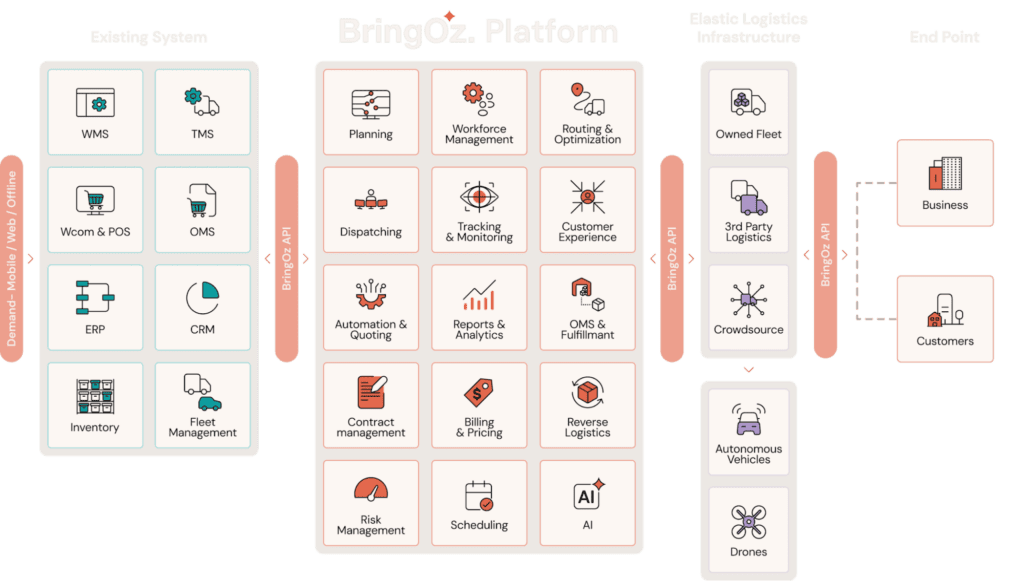
TMS integration in last-mile delivery creates a seamless, two-way connection between your core transportation management system and your last-mile delivery execution platform. Customer orders, shipment details, and scheduled loads flow instantly from the TMS to live dispatch, while status updates, exception alerts, proof-of-delivery records, and actual arrival times sync back automatically. While the TMS remains the central system of record for freight management, the execution layer handles real-time road operations.
By allowing each platform to focus on its dedicated role, teams eliminate the need for manual data re-entry. Most operations require an integrated architecture connecting the ERP, TMS, and last-mile execution layer. Because the ERP serves as the system of record for orders and invoicing, delivery confirmations and billing details must flow back to it. Designing these three connections together from the start eliminates data silos and streamlines end-to-end workflows.
Where does a TMS stop and last-mile execution start?
A TMS plans and procures transportation. A last-mile execution layer runs vehicles, drivers and stops on the day. Some TMS platforms include basic routing, so the line is not always clean, but the split below holds for most enterprise stacks.
| Area | Typically owned by the TMS | Typically owned by the last-mile execution layer |
| Freight procurement | Carrier selection, tendering, rate management | Not in scope |
| Planning | Load building, mode selection, lane planning | Stop sequencing against time windows, vehicle capacity and driver rules |
| Dispatch | Tendering loads to carriers | Assigning routes to drivers and reassigning them during the day |
| Changes during the day | Shipment status updates | Re-optimizing live routes when delays, cancellations or urgent orders appear |
| Driver workflow | Usually none | Driver app with stop details, exception reporting and proof of delivery |
| Customer communication | Shipment-level tracking | Stop-level ETAs and notifications |
| Settlement | Freight audit and payment | Pricing and settlement per stop, route or delivery provider |
If most of your problems sit in the right-hand column, a new TMS will not solve them. You would be buying a better version of the tool that already works.
Should you replace your TMS or add a last-mile execution layer?
Integrate when your TMS still does its own job well. Replace it when the TMS itself is the problem. Use the signals below to tell which situation you are in.
| What you see | Points to | Why |
| Freight rates, tendering and carrier management work fine | Integrate | The problem is downstream of the TMS |
| Problems start after vehicles leave the depot: missed windows, manual rerouting, missing proof of delivery | Integrate | Stop-level execution is outside what most TMS platforms were designed for |
| You run your own fleet, contractors and third-party carriers with no single view | Integrate | Coordinating mixed fleets on the last mile is an execution job |
| The TMS cannot send or receive data through APIs, webhooks or EDI | Replace or upgrade | Without a way to exchange data, there is nothing to integrate with |
| The TMS fails at rating, tendering or multimodal planning | Replace | An execution layer will not fix freight planning |
| Several business units run different TMS instances | Integrate first, consolidate later | A single execution layer unifies operations across systems while you work to streamline your software stack |
What about TMS alternatives?
Teams searching for TMS alternatives are often looking for better control of the last mile. That is a different purchase. Swapping one TMS for another moves the same gap to a new vendor, unless the new system also runs stop-level execution.
How does a last-mile execution layer connect to your TMS and ERP?
It connects through APIs, webhooks or EDI, in a loop: orders go out, and outcomes come back. Each step below is a data handoff that otherwise happens by email, spreadsheet or phone.
- Order intake. The TMS or ERP sends orders, addresses, items, time windows and service requirements.
- Planning and dispatch. The execution layer builds routes against vehicle, driver and time-window constraints, then dispatches them to drivers.
- Live execution. When delays, cancellations or urgent orders appear, routes are re-optimized and drivers get the changes in their app.
- Status back to the TMS. Stop-level status, ETAs and exceptions flow back as events, so the TMS shows where each shipment really is.
- Close-out to the ERP. Delivery confirmations, proof of delivery, partial deliveries and settlement data reach the ERP for invoicing.
BringOz connects to ERP, CRM, WMS, TMS, telematics and HR systems through REST APIs, webhooks and connectors. Data can sync in real time or in scheduled batches. You can see the supported systems on the BringOz integrations page. For details on security, governance, and deployment, explore our dedicated solution guide for IT leaders.
Why isn’t a transportation plan enough on its own?
While traditional transportation plans are set before operations begin, last-mile conditions evolve hourly. Plans assume every address is reachable, every customer is available and traffic behaves. The moment any variable shifts, the plan becomes obsolete, and the tolerance for such disruptions continues to shrink. According to an AlixPartners survey, US consumers now assume free delivery within 2.6 days, down from 3.5 days in recent years. In the same survey, 68% of executives named better ETA accuracy and reliability as their top AI priority. A plan built the night before cannot keep those promises by itself.
Government data shows that US eCommerce sales reached $347.3 billion in the third quarter of 2026. That is 17.9% of total retail sales and 10.4% more than a year earlier, according to the US Census Bureau. As online shopping continues to expand and shift consumer expectations toward shorter fulfillment windows, logistics companies face growing pressure to replace static scheduling models with dynamic, real-time last-mile execution tools capable of managing complex, high-volume last-mile logistics operations.
What does moving from plans to live decisions look like?
The plan becomes the starting point, not the instruction. The execution layer re-optimizes routes as conditions change, inserts urgent orders into active routes and flags delays before the customer calls. It also compares planned activity with what actually happened, so planners learn which assumptions failed and fix them in tomorrow’s plan.
Last-mile TMS vs. delivery orchestration: replace, integrate or coexist?
Most enterprises end up with the two coexisting. A last-mile TMS usually means a TMS vendor’s final-mile module. Delivery orchestration coordinates every last-mile resource, including your own fleet, contractors and third-party carriers, under one set of rules.
| Approach | How it works | Best fit | Check before you commit |
| Replace | A new TMS with a final-mile module runs freight and the last mile | You are already replacing the TMS for freight reasons | How deep the module goes: driver app, live rerouting, proof of delivery, mixed fleets |
| Integrate | Keep the TMS and connect a delivery orchestration layer to it | The TMS handles freight well; the last mile needs stop-level control | Which system owns each data field |
| Coexist with set boundaries | The TMS owns middle-mile freight; orchestration owns last-mile execution across all fleet types | Mixed fleets, several business units or several TMS instances | Where the handoff happens, and who monitors it |
BringOz is built to run alongside existing systems rather than replace them. You can start with one region, one business unit or one order type, then expand once the integration is proven.
Key questions to consider before moving forward
Before deciding whether to replace your existing TMS or enhance it with a last-mile solution, assess your current operational needs and capabilities rather than relying solely on vendor promises. Start by evaluating the following key areas:
- Data connectivity: Can your existing TMS support automated data exchange through APIs, webhooks, or EDI to send orders and receive real-time status updates?
- Decision-making workflows: Which operational decisions are managed directly within your TMS, and which still depend on manual processes such as spreadsheets, phone calls, or messaging platforms?
- System of record: Which system acts as the single source of truth for delivery statuses, proof of delivery, and billing information?
- Fleet management: Do you need a unified operational view covering your internal fleet, external contractors, and third-party carriers?
- Implementation strategy: Can the rollout be phased incrementally by region, business unit, or order type?
- Ownership & governance: Which team will take the lead in defining integration requirements and coordinating implementation: IT, operations, or a collaborative team involving both?
Is your TMS managing freight while your last-mile operations rely on manual workarounds? Book a demo to see how BringOz integrates with your existing technology stack.
Frequently asked questions
No, not if your TMS still handles freight planning, tendering and carrier management well. Most last-mile problems, such as missed windows, manual rerouting and missing proof of delivery, sit outside what a TMS was built for. Integrating a last-mile execution layer fixes those without a full system replacement.
ERP-TMS integration connects your enterprise resource planning system with your transportation management system, so orders and billing data move between them automatically. For deliveries, the ERP should also receive delivery confirmations, proof of delivery and partial deliveries, so finance can invoice as soon as work is complete.
Not quite. A last-mile TMS is usually a final-mile module inside a transportation management system. A delivery orchestration platform coordinates every last-mile resource, including your own fleet, contractors and carriers, under one set of rules. Many enterprises run both, with the TMS owning freight and orchestration owning execution.
At a minimum, the integration should return stop-level delivery statuses, updated ETAs, exception alerts, and proof of delivery. This ensures the TMS maintains accurate shipment visibility and supports effective customer service. Settlement and billing information typically flow into the ERP, so it is important to define upfront which system serves as the source of truth for each data element.