
AI & Rule Engine
Automates decisions and actions using configurable rules and AI signals to optimize operations, reduce manual effort, and respond intelligently in real time.




Optimization & Planning Intelligence
AI-Powered Planning Optimization
Optimize plans using AI and real-time data.
Multi-Objective Optimization
Balance cost, service, time, and capacity.
Continuous Optimization
Re-optimize plans as conditions change.
Scenario-Based Optimization
Compare scenarios to guide decisions.



Operational Recommendations Engine
Generate AI-driven recommendations to improve daily operations.
Next-Best-Action Suggestions
Suggest optimal next actions in real time.
What-If Recommendation Analysis
Provides alternative decisions before acting.
Human-in-the-Loop Decision Support
Keep humans in control with AI-assisted guidance.
Recommendations & Decision Support
Performance, Utilization & Efficiency Intelligence
Utilization Analytics
Analyze how resources are used across operations.
Idle Time & Waste Detection
Identify inefficiencies, idle time, and wasted capacity.
Service-Level Risk Prediction
Predict SLA and service-level risks before they occur.
Continuous Learning
Continuously learn to improve future performance.
Advanced Rule Control
Gain flexibility, scale, and operational robustness.

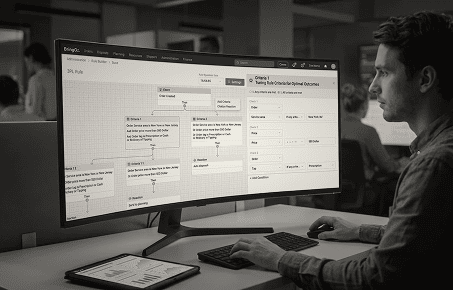
Rule Definition & Logic
Define rules using structured if/then logic and outcomes.

Scope, Context & Inheritance
Apply rules by entity, role, geography, and hierarchy.

Priority & Conflict Handling
Control execution order and resolve rule conflicts.

Activation, Scheduling & Reuse
Activate, schedule, and reuse rules across modules.

Simulation & Impact Testing
Test rules using historical or simulated data in real-time.

Exceptions & Overrides
Support controlled manual overrides with full traceability.



Enterprise Governance & Scale
Manage global control, compliance, and enterprise complexity.

Role-Based Rule Control
Manage who can create, edit, approve, and deploy rules.

Approval & Change Governance
Enforce approval workflows for rule and governance changes.

Audit & Traceability
Track and trace full rule history and execution logs.

Policy & Compliance Enforcement
Encode regulatory and internal policies as rules.

Enterprise-Scale Execution
Run rules at high volume with low latency at enterprise scale.

Cross-Module Orchestration
Apply rules consistently across planning, execution, and analytics.
FAQs
BringOz applies AI to planning, routing, scheduling, prediction, anomaly detection, recommendations, and real-time operational decisions.
Yes. Operational signals can be analyzed to identify emerging risks, delays, capacity issues, or likely service failures.
It can surface insights and recommend next actions such as reassigning work, adjusting plans, or addressing exceptions.
Yes. BringOz can use live conditions to support continuous re-optimization as demand and execution change.
It automates repetitive decisions, identifies inefficiencies, prioritizes work, and helps teams focus on higher-value exceptions.
Yes. Connected operational data can provide context for planning, prediction, optimization, and recommendations.
Yes. Organizations can combine automated decisioning with thresholds, approvals, policies, and manual intervention.
The same operational data, rules, and optimization framework can support planning, dispatch, field service, delivery, and exception workflows.
Optimization objectives, constraints, rules, and decision logic can be configured around your service, cost, capacity, and operational goals.
It helps organizations make faster decisions, reduce inefficiency, improve service performance, and operate more proactively.
Curious about
pricing?
BringOz pricing depends on several factors. To provide an accurate quote, please complete the form and we’ll connect you with the right expert shortly.