Logistics software is the set of systems that plan, run and track the movement of goods. The main types are ERP, WMS, TMS, delivery management, fleet telematics, field service management, supply chain planning and shipment visibility. Each one owns a different stretch of the operation, from order entry to the customer’s door. This guide outlines the different types of logistics software alongside their respective limitations. It also provides a checklist to help you identify the optimal solution for your business.
Key Takeaways
- ERP platforms hold the order, the inventory value and the invoice. They record logistics; they do not run it.
- WMS systems run everything inside the warehouse, up to the dock door.
- TMS solutions plan and buy freight: modes, carriers, rates and loads.
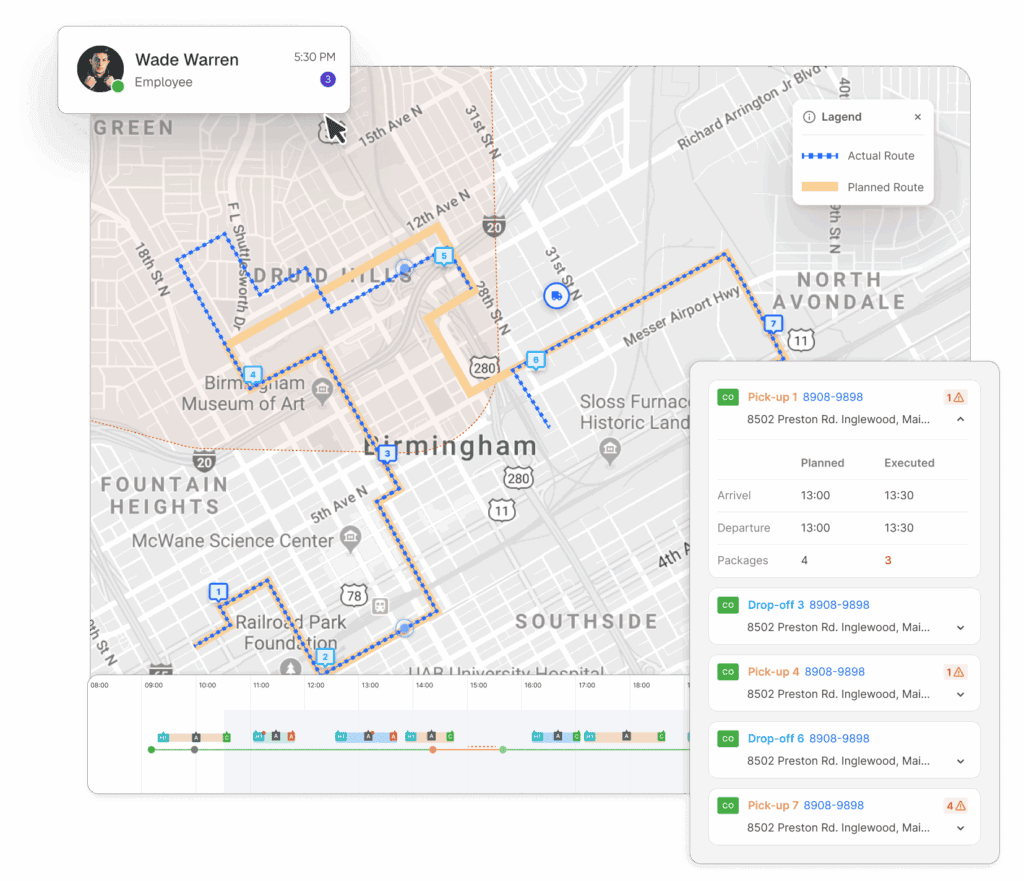
- Delivery management software oversees and coordinates end-to-end delivery operations, including dispatching, route planning, driver tracking, and proof of delivery.
- Telematics, field service, planning and visibility tools each cover one narrower job: vehicles, site jobs, forecasts or delivery status.
What is logistics software?
Logistics software is any system that plans, executes or monitors the storage and movement of goods. It covers the warehouse, the freight network and the final delivery, along with the records that tie them to orders and invoices.
Some software plans: it decides what should happen, such as a forecast, a load plan or a route. Some software executes: it tells people and vehicles what to do now and changes the instruction when something goes wrong. Some software only observes: it reports where things are without acting on it.
The types of logistics software
| Type | What it manages | Where it sits in the operation | Who owns it internally | What it does not do |
| Enterprise resource planning (ERP) with embedded supply chain | Orders, inventory value, procurement, finance | Across the business, as the system of record | Finance and IT | Run warehouse tasks, dispatch drivers or react to events during the day |
| Warehouse management system (WMS) | Receiving, storing, picking, packing, inventory location | Inside the warehouse, up to the dock door | Warehouse and distribution center operations | Plan freight or manage anything after the truck leaves |
| Transportation management system (TMS) | Freight planning, carrier selection, rating, load building, freight audit | First and middle mile, between facilities | Transportation or logistics team | Run stop-level execution: driver apps, live rerouting, proof of delivery at the door |
| Delivery management and last-mile orchestration | Dispatch, route optimization, drivers, live tracking, proof of delivery | Last mile, from the dock to the customer | Delivery and fleet operations, dispatchers | Procure line-haul freight or manage warehouse inventory |
| Fleet telematics and vehicle management | Vehicle location, engine data, driver behavior, maintenance | On the vehicle | Fleet and maintenance managers | Decide which stops a vehicle should make or in what order |
| Field service management | Technician jobs, skills, appointments, work orders | At the customer site | Service operations | Plan dense delivery routes with many short stops |
| Supply chain planning | Demand forecasts, supply plans, inventory targets | Weeks to months ahead of execution | Supply chain planning and S&OP teams | Act on what happens today |
| Freight and shipment visibility | Shipment status and predicted arrival across carriers | Above the network, watching it | Logistics, customer service | Change a route, reassign a driver or resolve an exception |
ERP with embedded supply chain
Serving as the core system of record, an ERP centralizes business data, including sales and purchase orders, supplier and customer details, inventory value, and the general ledger. It handles the entire lifecycle of a transaction, from order creation to invoice settlement. Enterprise platforms like SAP S/4HANA and Microsoft Dynamics 365 Supply Chain Management also incorporate dedicated modules for warehousing, transportation, and operational planning.
The problem an ERP solves is consistency: one version of the order, the price and the stock count. Finance and IT usually own it, and changes go through formal release cycles.
The boundary is speed. An ERP records what happened; it is not built to react to a late driver at 2 p.m. Execution systems, from the WMS to delivery management, sit beside it, take orders from it and report outcomes back.
Warehouse management systems
A WMS runs the inside of the building: receiving, storing, replenishment, picking, packing and cycle counts. It knows which bin holds which item, and it directs workers through scanners or mobile devices. Microsoft’s Warehouse Management mobile app, for example, takes workers through receiving, picking, storing and cycle counting tasks. Microsoft also offers a warehouse-only mode for companies that keep a different ERP.
Accuracy within warehouse operations dictates downstream efficiency and customer satisfaction, as even a minor picking error inevitably escalates into a costly failed delivery. The boundary is the dock door. A WMS can stage outbound orders by route or wave, but once a vehicle pulls away, the WMS has no view of the delivery.
Transportation management systems
A TMS serves as the primary hub for planning, executing, and optimizing the physical movement of freight. Operating mainly in the first and middle miles between suppliers, manufacturing, and distribution centers, it manages multi-facility logistics. Key operational capabilities include selecting transport modes and carriers, rating shipments, consolidating orders into loads, electronic tendering, and auditing freight bills.
However, the boundary of a TMS is the individual stop. While a TMS excels at ensuring a shipment or load leaves a dock on time and tracks high-level visibility between facilities, it is not designed for granular last-mile execution. It cannot sequence 120 dense delivery stops for an individual driver, push dynamic rerouting updates to a driver’s mobile device mid-route, or manage doorstep proof-of-delivery workflows.
Delivery management and last-mile orchestration
Delivery management and last-mile orchestration platforms handle delivery operations end-to-end, covering the journey from the dock door to the end customer where operational variability is highest. Last-mile orchestration ensures all available assets and resources function seamlessly under unified rules.
The core capabilities include:
- Dispatch: assigning orders to drivers and vehicles, and reassigning them during the day.
- Route planning and optimization: sequencing stops against time windows, vehicle capacity and driver rules, then re-optimizing when conditions change.
- Real-time tracking with predictive ETA: live driver location, plus arrival estimates that update as the route unfolds.
- Proof of delivery: signatures, photos, scans and timestamps captured at the door.
- Driver management: availability, qualifications, hours and the driver app itself.
Managing a mixed fleet, combining internal assets, third-party contractors, gig drivers, and 3PL carriers within a single operational framework, presents a complex operational challenge. Companies must balance financial investment with operational oversight across each fleet model:
| Fleet type | Cost profile | Control |
| In-house fleet | Mostly fixed: vehicles and drivers cost money on slow days too | Highest: you set the service standard and train the drivers |
| Contractors | Semi-flexible pricing, typically calculated on a per-day or per-route basis | Moderate: you set rules, but enforcement depends on the contract |
| Gig partners | Pay-per-task model providing flexible scaling during peak demand periods | Lowest on consistency and handling |
| 3PL carriers | Per package or per stop, with no assets to carry | Limited to what the carrier exposes through integration |
Shippers are re-evaluating these priorities. In AlixPartners’ 2026 survey, reliability overtook cost as the main reason shippers choose a last-mile partner. BringOz can help companies ensure reliable and efficient delivery service by enabling operations to orchestrate internal fleets, independent contractors, partners, and external 3PLs within a unified model. By integrating live tracking, driver applications, proof of delivery, and route optimization, it serves as the daily operational center for dispatchers and delivery managers.
Fleet telematics and vehicle management
Fleet telematics and vehicle management software concentrate on asset-level monitoring and upkeep. Telematics solutions collect real-time vehicle data, including location, speed, engine health, idling time, and driver conduct, while vehicle management functions handle maintenance scheduling, inspections, and compliance documentation.
These tools aim to optimize vehicle utilization, ensure safety, and minimize cost per mile. However, their primary role is observational: while telematics can flag a truck stopped nearby, it lacks context regarding delivery time windows, stop sequences, or order reassignments. Consequently, delivery management platforms frequently ingest telematics data to guide real-time dispatch decisions.
Field service management
Field service management systems schedule site-based technician assignments, including installations, maintenance visits, repairs, and inspections. The system aligns every job with required technician skills, certifications, necessary parts, and specified customer appointment windows while logging completed tasks.
Unlike delivery operations that focus on high-density stops optimized by sequence and strict time windows, field service prioritizes thorough onsite task completion. Technicians typically handle four to five long-duration visits per day, with each job requiring linked work orders, service histories, parts tracking, and clear customer communication to ensure site access. For hybrid workflows, such as product delivery paired with onsite installation, coordinating both models within a single order workflow is critical.
Supply chain planning
Supply chain planning solutions focus on long-term strategy, deciding operational targets weeks or months in advance. It handles demand forecasting, supply and production scheduling, inventory positioning, and sales and operations planning (S&OP). Its core objective is to ensure inventory is properly located prior to order placement. Because its scope is defined by time, a strategic decision established months prior cannot resolve real-time operational shifts, such as rerouting a delivery vehicle mid-week. Consequently, planning models serve as inputs to operational execution platforms rather than direct substitutes.
The operational handoff occurs where strategic forecasts interact with live execution. Effective planning software establishes the volume baselines and stock thresholds that dictate operational boundaries. Execution systems feed actual performance data back into the workflow, enabling subsequent forecasts to build upon real-world demand patterns rather than initial projections.
Freight and shipment visibility
Shipment visibility platforms aggregate status updates across carriers, tracking devices, and partner networks to deliver end-to-end network tracking. These systems tackle the primary customer question, “Where is my order?” This allows logistics management and customer support teams to pinpoint potential delays early and minimize inbound customer calls.
Their value is greatest in multi-carrier operations operating with fragmented reporting formats. However, visibility tools are restricted by their inability to execute direct operational adjustments. They can alert teams to a missed delivery window, but cannot change routes or schedules. Operational platforms incorporating centralized visibility bridge this gap, empowering teams to act immediately upon real-time alerts.
Where the categories overlap, and what that costs you
Overlap is where budgets leak. In each pair below, each system has a clear job. The other system is the right answer for part of the work.
| Comparison | The other system is the right answer when | Delivery management is the right answer when | Cost of getting it wrong |
| TMS vs. delivery management | You are planning and buying line-haul freight between facilities | You are dispatching many stops a day to drivers you manage | Stop-level work runs on spreadsheets beside a TMS that cannot see it |
| WMS vs. delivery management | The work happens inside the building, up to the dock door | The work starts when the vehicle leaves | Route plans and pick waves disagree, and trucks wait at the dock |
| Telematics vs. delivery management | You need vehicle health, safety and maintenance data | You need to decide what the vehicle does next | Dispatchers watch dots on a map and make every change by phone |
| Field service vs. delivery management | The day is a few long jobs needing skills and parts | The day is many short drops where sequence matters | Route density suffers, or technicians get scheduled like couriers |
Most mid-size and enterprise operations run several of these at once. The goal is not one system for everything. It is a clear owner for each step, with integrations between them.
Still juggling vehicles, routes and delivery windows? See a smarter way to dispatch.
How to choose logistics software
The following evaluation checklist highlights key questions, optimal vendor responses, and potential red flags across critical implementation criteria:
| Criterion | Question to ask the vendor | A good answer | A red flag |
| Miles covered | Which miles does it run: first, middle or last? | It names the miles it executes and the systems it hands off to | “End to end” with no detail on stop-level dispatch |
| Fleet model | Can it dispatch in-house drivers, contractors, gig partners and carriers in one model? | One dispatch board, with rules set per fleet type | Carriers handled only as a label-printing step |
| Integration surface | Is it API first, and which integrations exist for our ERP, WMS, TMS and telematics? | Documented APIs and webhooks, plus existing connectors for your systems | Every integration quoted as a custom project |
| Execution or visibility | When a delivery runs late, what does the system do? | It reroutes, reassigns or alerts with a recommended action | It shows a red marker on a map |
| Modular or monolithic | Can we start with one capability, region or business unit? | A phased rollout plan with a defined first phase | The full suite must go live before anything works |
| Deployment time | How long for an operation like ours, and can we speak to that customer? | A timeline split into data, integration and training, backed by a reference | A single number with no reference customer |
| Unit of measure | Which of our metrics will this move, and how will we measure it? | A baseline on cost per delivery, asset utilization or on-time delivery rate | Efficiency claims with no baseline |
Frequently asked questions
Logistics software is any system that plans, executes or monitors how goods are stored and moved. It ranges from ERP and warehouse management to transportation management, delivery management and shipment visibility. Most operations run several of these, each owning a different stretch from order entry to the customer’s door.
A TMS typically manages the movement of freight between locations, including carrier selection, freight rates, planning and shipment tracking. Delivery management software focuses on the delivery operations, coordinating vehicles, drivers, routes, dispatch and delivery time windows. Some platforms cover both, but last-mile delivery operations often need more granular control over daily execution.
Look for real-time visibility, automated planning, route optimization, dispatch management, fleet tracking, delivery notifications and proof of delivery. For more complex operations, dynamic reallocation and the ability to respond to changing delivery constraints are equally important. The right feature set depends on where your operation needs better control.
Yes, but not every platform supports both equally well. Look for software that can coordinate owned vehicles, subcontractors and third-party carriers within the same operational model. This gives dispatchers a unified view of capacity, availability, delivery progress and performance without switching between systems.
Logistics software typically integrates with ERP, WMS, TMS, eCommerce and order management systems, telematics, and carrier platforms. Orders flow in from the ERP or store, and status, proof of delivery and billing data flow back. Look for API-first systems with documented connectors for the tools you already run.
Managing different fleet types? Bring them together in one unified system. Book a demo to see a mixed fleet run from a centralized dashboard.