Every last mile delivery demo looks alike: a map, moving dots, a driver app and a dashboard. The differences show up later. That is when the system meets 400 stores, three fleet types, two business units and an ERP that was never built to talk to it.
This guide lists 15 requirements that decide whether last mile delivery software works for your enterprise operation. For each one, it says what to look for and how to test it in a demo. Use it to cut a long vendor list down to the few worth piloting. The goal is the best last mile delivery software for how you actually run.
Choosing last mile delivery software? Book a demo and test it on your hardest delivery day.
Key Takeaways
- The best last mile delivery software for an enterprise holds your real rules at real scale. A good demo map proves very little.
- The 15 requirements below fall into five groups: planning and routing, dispatch and fleet, drivers and proof, visibility and customers, and integration and control.
- Three requirements separate enterprise platforms from point tools: unified mixed-fleet orchestration, configurable rules by business unit, and API-first integration with your ERP, WMS and TMS.
- Test every requirement against a day of your own orders before you shortlist.
What makes the best last mile delivery software for enterprise operations?
The best last mile delivery software for enterprise operations is the platform that can run your actual constraints, fleets and systems without workarounds. Feature lists overlap. What differs is how far each platform bends to your operation before your planners start working around it.
| # | Requirement | Why it matters at enterprise scale |
| 1 | Constraint-based route optimization | Plans that ignore your rules get rebuilt by hand |
| 2 | Live route re-optimization | The day never runs to plan |
| 3 | Multi-depot and territory planning | Most enterprises deliver from more than one site |
| 4 | Unified mixed-fleet orchestration | Own drivers, contractors and carriers in one view |
| 5 | Dynamic priority-based order allocation | Urgent and SLA orders must move first |
| 6 | Controlled manual overrides | Dispatchers need control without breaking the rules |
| 7 | Configurable driver app | Different services need different steps |
| 8 | Electronic proof of delivery | Disputes and billing depend on it |
| 9 | Real-time tracking and ETA updates | Customers and dispatchers need the same live picture |
| 10 | Automated customer notifications | Fewer missed deliveries and status calls |
| 11 | Exception management | Problems should be caught before customers notice |
| 12 | API-first integration | Orders and outcomes must flow without manual entry |
| 13 | Configurable rules engine | Business units and regions run differently |
| 14 | Analytics & planned vs. actual performance | You cannot fix what you cannot compare |
| 15 | Enterprise security and governance | Access, audit trails and approvals at scale |
Which planning and routing requirements matter most?
Routing that reflects your real constraints matters most, because every other step inherits the plan. A plan that ignores one rule becomes a manual job for a dispatcher every morning.
1. Constraint-based route optimization
The platform should plan around time windows, vehicle capacity and type, driver skills, labor rules and service levels at the same time. Hours rules alone can break a plan. If your fleet includes commercial motor vehicles, federal hours-of-service rules cap driving at 11 hours after 10 consecutive hours off duty. They also require a 30-minute break after 8 cumulative hours of driving. Test it: load a day with tight windows and mixed vehicle types, and check whether any route breaks a rule.
2. Live route re-optimization
Routes should be recalculated during the day as orders, delays and cancellations come in, and the changes pushed to drivers. Test it: insert an urgent order mid-route and watch what moves.
3. Multi-depot and territory planning
The platform should plan across depots and stores, respect territory ownership, and rebalance when one site is short of capacity. Test it: plan the same orders from two depots and see how the load is split.
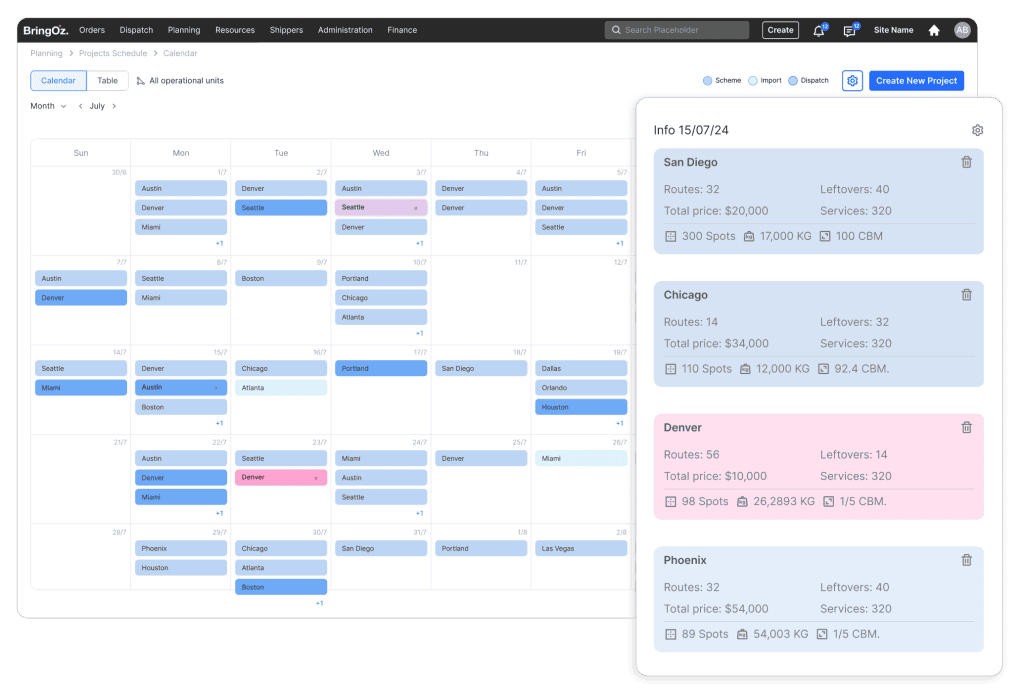
BringOz route optimization covers all three, with rules that can differ by region or business unit.
What should dispatch and fleet management handle?
Dispatch should handle every resource you use, under one set of rules. For most enterprises that means a mix of company drivers, contractors, partners and carriers, each with its own cost and level of control.
4. Unified mixed-fleet orchestration
Manage internal drivers, third-party contractors, delivery partners, and commercial carriers within a single operational framework. The system should apply customized routing parameters and billing rules tailored to each fleet type. Unifying these channels is essential to offset escalating logistics expenses.
According to a 2026 logistics report by Kearney for CSCMP, US parcel and last-mile delivery are undergoing a structural reset. Carrier costs have also reset, with 5.9% general rate increases along with additional fuel and accessorial surcharges. Test it: ask the vendor to dispatch one order to your own driver and the next to a carrier, from the same screen.
5. Dynamic priority-based order allocation
Orders should be matched to drivers automatically, using priority, SLA, proximity, vehicle capacity and qualifications. Test it: add an emergency order and check that it is prioritized instantly without disrupting existing commitments.
6. Controlled manual overrides
Dispatchers need to reassign or reroute by hand, but only within permissions you set. Test it: ask who can override what, and where the change is recorded. See how real-time dispatching brings these into one workflow.
What do drivers and proof of delivery require?
They require a driver app that fits each service and captures evidence at the door.
7. Configurable driver app
Tailor workflows, delivery instructions, required tasks, and exception protocols to specific order categories, customers, or service types. A pallet drop, a pharmacy delivery and an installation should not share one rigid flow. Test it: configure two different workflows and switch between them.
8. Electronic proof of delivery
Captures essential delivery data, including customer signatures, photos, barcode scans, timestamps, and notes, directly within the mobile app and automatically attaches it to the corresponding order record. Test it: complete a delivery and check how fast the proof reaches your ERP or billing system.
What visibility and customer features should you expect?
You should expect a single, unified live view shared across dispatch teams, customer service, and the end customer. When teams work off inconsistent operational data, it inevitably leads to manual follow-up calls to drivers.
9. Real-time tracking and ETA updates
Live driver location and route progress, with arrival estimates that update as the route changes. Test it: delay a stop and see whether the ETAs for later stops move.
10. Automated customer notifications
Keep customers informed with custom-branded alerts triggered by key milestones, such as order dispatch, driver on the way, arrival, and final delivery. Test it: verify if notification triggers, delivery channels, and message timing can be customized per customer or service.
11. Exception management
Identify delays, failed delivery attempts, and SLA risks automatically. The system should prioritize these issues by severity and direct them to the appropriate team for prompt resolution. Test it: evaluate the platform’s automated response when a delivery is at risk of missing its committed time window. A centralized visibility layer puts all three on one screen.
What integration and control requirements do enterprises need?
Enterprises need a platform that connects to existing systems and adapts to each business unit without custom code. This group determines deployment speed and long-term system stability post-implementation.
12. API-first integration
Provides pre-built connectors alongside REST APIs and webhooks to synchronize with ERP, WMS, TMS, telematics, and order management platforms, supporting both real-time streaming and batch schedules. Test it: ask for the connector list and a reference customer on your ERP. BringOz lists its integrations publicly.
13. Configurable rules engine
Allows teams to adjust assignment, routing, priority, and approval parameters across regions, business units, customers, or services without requiring custom development work. Test it: change a rule during the demo and check that it applies to the next plan.
14. Analytics & planned vs. actual performance
Compares planned routing with real-world execution while tracking key performance indicators across different regions, operational teams, and customer accounts. Test it: ask for on-time rate, cost per delivery and failed attempts for one region over one week.
15. Enterprise security and governance
Ensure system reliability across regions with multi-level role permissions, end-to-end audit logs, workflow approval triggers, and robust data controls. Test it: ask to see the audit trail for a single changed route.
How should you run the evaluation?
Evaluate platforms using your actual operational data rather than vendor demo setups.
- Score the long list. Use the 15 requirements to cut it to three or four vendors.
- Send a real day of orders. Include your hardest constraints: tight windows, mixed vehicles, urgent orders.
- Watch the exceptions. Ask each vendor to handle a late driver, a cancelled order and an urgent insert live.
- Check integration early. Get your IT team on the call that covers APIs and connectors.
- Run a phased pilot. Begin with a single region, specific order type, or defined business unit, keeping success criteria clearly defined.
- Call references. Ask for a customer with a similar fleet mix and ERP.
Ready for smarter fleet orchestration? Book a demo to learn how you can bring every fleet together and manage operations from one place.
Frequently asked questions
There is no single best option for every enterprise. The right platform is the one that handles your constraints, fleet mix and systems without workarounds. Focus on unified mixed-fleet orchestration, configurable rules by business unit and API-first integration, then test each shortlisted vendor on a day of your own orders.
Usually, yes. Last mile delivery companies need tools for many clients, such as per-client rules, branded notifications and settlement by customer. Shippers with their own fleets focus more on integration with their ERP and WMS. Many enterprises are both, so the platform should support both models.
Yes, if it supports mixed fleet dispatch. The platform should assign orders to company drivers, contractors, partners and carriers under one set of rules, with settlement logic for each. Without that, dispatchers end up managing each fleet type in a separate tool.
Test it on a real day of your own orders, including tight time windows, mixed vehicles and urgent inserts. Ask each vendor to handle live exceptions in the demo. Then pilot one region or business unit with clear success measures before rolling it out further.