
How Leading Organizations Increase Coverage, Productivity, and Customer Value Through Smarter Territory Design
Executive Summary
Territories are often viewed as an operational necessity, a convenient way to divide customers, locations, or regions among employees. However, territory design has a direct impact on revenue growth, customer satisfaction, workforce productivity, and operational costs.
Many organizations continue to operate with legacy territories that were designed years ago and have evolved through incremental adjustments rather than strategic, data-driven planning. As markets change, customer bases expand, and workforce structures evolve, these outdated territory models create deep operational inefficiencies that limit growth.
The consequences are significant:
- High-value customers receive insufficient attention.
- Employee workloads become severely unbalanced.
- Travel time increases exponentially.
- Customer coverage declines.
- Revenue opportunities are missed.
Leading organizations are recognizing that territory optimization is not simply an administrative or operational exercise, it’s a strategic growth initiative. This paper explores the business impact of territory design, common challenges organizations face, and practical approaches for creating territories that support both operational efficiency and revenue growth.
The Territory Problem Most Organizations Ignore
As organizations grow, territories tend to evolve organically. New customers are added, employees are reassigned, regions expand, and business priorities change. Over time, the original territory structure becomes misaligned with business objectives.
Common symptoms of structural territory decay include:
- Some employees are overloaded while others operate with excess capacity.
- Travel times continue to increase.
- Customer visit frequencies become highly inconsistent.
- Managers struggle to achieve coverage goals.
- High-value customers receive the same attention as low-value accounts.
Many organizations respond to these challenges by hiring additional employees, when the underlying problem is often inefficient territory design.
Why Territory Design Matters
Territories determine how an organization’s most valuable resource – its workforce – is deployed. Every territory decision affects:
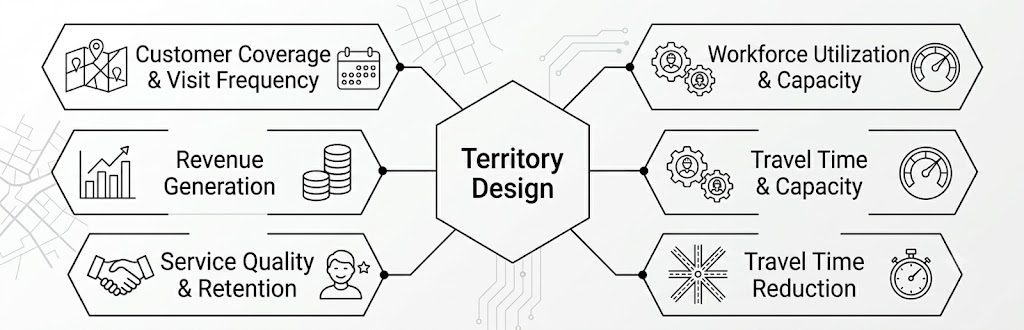
Poor territory design creates compounding daily inefficiencies. Conversely, well-designed territories create a stable foundation for scalable, predictable growth.
The Hidden Costs of Poor Territory Design
Uneven Workloads
One of the most common challenges is workload imbalance. Assigning territories with an equal number of accounts assumes the workload is identical, which completely ignores differences in account complexity, sales potential, and travel time. This leads to employee burnout, excessive overtime expenses, missed customer visits, and reduced productivity. Balanced territories allow organizations to maximize workforce utilization without increasing labor costs.
Excessive Travel Time
Travel time is often one of the largest hidden costs in field operations. Poor territory boundaries force employees to spend hours traveling between far-flung locations rather than serving customers. This results in lower productivity, increased operating costs, reduced customer interaction time, and higher employee frustration. Even small reductions in daily travel time can create substantial, unworked operational capacity that can be redirected toward high-potential markets.
Inconsistent Customer Coverage
When territories are not aligned with customer demand, service levels become highly inconsistent. Some customers receive excessive attention while others are underserved. This imbalance creates severe risks, including lost sales opportunities, lower customer satisfaction, reduced account growth, and increased customer churn.
Missed Revenue Opportunities
Revenue growth depends on consistent, targeted customer engagement. Organizations that cannot effectively prioritize high-value customers frequently struggle to maximize account potential. Territory design directly influences visit frequency, relationship development, sales effectiveness, and market penetration.
Moving Beyond Geographic Territories
Historically, territories were primarily designed around geography. While geographic efficiency remains important for field teams, modern territory optimization requires a broader, multi-dimensional perspective. Today’s organizations must consider:
- Customer Value: Not all customers contribute equally to business growth. Territories should reflect account importance, revenue potential, and strategic priorities using segmented scoring models.
- Workforce Capacity: Territories should align with the actual, realistic capacity of employees rather than arbitrary geographic boundaries.
- Service Requirements: Different customer tiers require entirely different service frequencies, sales plays, and engagement models.
- Business Objectives: Territory design should explicitly support high-level growth goals, market expansion initiatives, and customer experience strategies.
The Modern Approach to Territory Optimization
Leading organizations are adopting data-driven approaches to territory management, replacing intuition or historical structures with advanced analytics.
| Key Component | Tactical Application |
| Territory Balancing | Creating equitable workloads and opportunity distribution across employees and teams. |
| Customer Prioritization | Allocating resources based on customer lifetime value, market potential, and business impact. |
| Route Optimization | Integrating smart routing paths to minimize travel time while maximizing face-to-face customer engagement. |
| Capacity Planning | Aligning territory assignments with actual employee availability, ramp times, and operational objectives. |
| Continuous Adjustment | Treating territories as dynamic assets that are reviewed and adjusted quarterly alongside shifting market data. |
The Connection Between Territory Optimization and Revenue Growth
The primary objective of territory optimization is not simply reducing travel time; the ultimate objective is enabling sustainable revenue growth.
Organizations that optimize territories can see 10% to 20% increases in sales productivity. They benefit from increased customer coverage, better service levels, improved sales effectiveness, higher workforce utilization, and significantly better market penetration.
What Leading Organizations Measure
Successful territory optimization initiatives focus on measurable business outcomes. Revenue operations teams commonly track the following health metrics:
- Customer coverage rate
- Visit frequency compliance
- Revenue per territory
- Workforce utilization rate
- Travel time and distance per employee
- Customer satisfaction and retention
- Cost per visit
- Quota attainment distribution
Conclusion
Territory design influences far more than operational efficiency; it affects customer relationships, employee productivity, workforce utilization, and ultimately revenue growth. As customer expectations increase and operating costs continue to rise, organizations can no longer afford to rely on static, outdated territory structures.
Modern territory optimization enables organizations to align workforce capacity with customer demand, reduce inefficiencies, and create a solid foundation for sustainable growth without simply adding headcount. The most successful organizations are no longer asking how to divide territories; they are asking how territory strategy can become a definitive competitive advantage.